This past January, I had the opportunity to escape the winter weather and visit India for a second time. My first trip in 2012 was to an ashram in southern India as part of a guided group of Westerners. The focus was inward, and we stayed on the ashram grounds where we had long periods of silent meditation. Because of this, we were shielded from what everyday life was like for the local Indian people. I remember one person from our group, who thought of himself as a resilient, seasoned traveler, went on his own to northern India for a week. When he returned to our group, he was badly shaken by his experiences and clearly had had a hard time navigating on his own. His struggles and feedback stayed with me.
And yet on this recent trip, I was determined to do the same thing he had done – to adventure out of the sheltered group setting and experience the real life and culture of local people. I decided to spend the first 8 days with other Westerners at an ashram in Kerala in southwest India. After that, and with careful planning, I hoped to navigate the northern part of the country on my own.
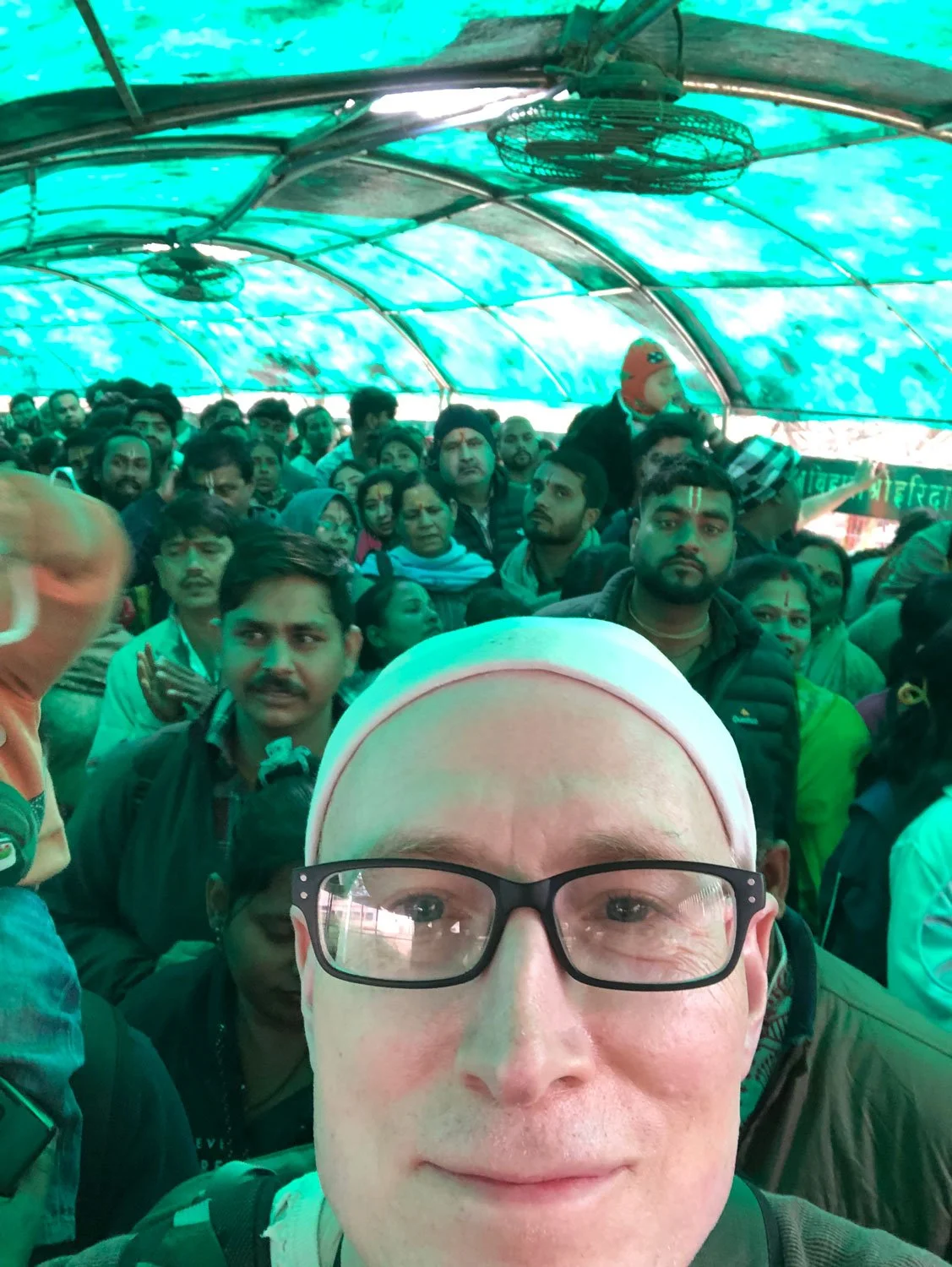
This trip really felt like two trips rolled into one. While the first part at the ashram was relatively easier, there were still challenges. The ashram was a bit crowded, with over 500 people there – mostly from France, the United States, and other Western cultures, though English was the primary language spoken and people were generally friendly. Of course, people were there for many different reasons, including spiritual growth and as a means of self-therapy. In such gatherings, people often arrive with a set of ideals about what they will find at the ashram, only to be confronted with reality – you can’t get a single room sometimes, people with differing cultural habits could seem rude, the heat and lack of air conditioning can feel stifling, an ashram can strike one as a bit dirty by Western standards, and so on. This can lead some attendees to being “triggered” and having to sort through mental, emotional, or physical challenges. But there are many opportunities for finding calm through meditations at the ashram, and some days I used meditations and exercises from the 5STOM Method* to calm my own rising tensions and help myself to be more discerning about whatever was triggering me at the moment.
The second part of the trip was very different and involved me flying to the north to see four cities in particular: Kolkata, Varanasi, Delhi, and Agra. The biggest challenge for me as a foreigner in these cities was all the attention I received – I felt like a moving target at times. Many locals would gravitate toward me whenever I was out walking. Drawn by financial need and for other reasons, there would often be a parade of people following me, whether I gave a donation or politely declined their service. People were not shy and many would persist for up to a half a block, asking me personal questions or wanting to have their picture taken with me. Young children would follow me, sometimes asking for money. And some people would try to sell me things or tell me things that weren’t true in order to secure some financial advantage. Though there was a lot of bustle around me, I never felt unsafe.
And, I noticed something interesting in the people and in myself.
One of the more striking differences between life in the U.S. and in India is that the culture in India seems more people-focused and less focused on efficiency and independence. In my experience, there is a higher value placed on community and interpersonal relationships in India. One man I spoke to owns a restaurant in Agra. He conceded that, while he will never have enough money to visit the U.S., he was happy with his life in a country that is quite affordable and enables him to focus on his daughter’s wedding in the coming year. A young man in his early 20’s that I met in a park in Kolkata was also looking forward to getting married soon and shared his ideas about having a wife. The sense of importance of being connected to others is pronounced, and appears to extend into a very active sense of community. For example, I saw quite a bit of poverty, especially in Kolkata where homeless people look emaciated and street dogs wander everywhere. However, despite their obvious struggles, the majority seemed calm and content with their lives, and it was clear that some are loosely cared for by the community around them. Seeing so many people struggling while also being immersed in this culture of interpersonal connectedness, I found it very natural to be compassionate to everyone I encountered. I noticed that people appreciated it when I would try to help them out, and the experience left me wondering if more could be done for them than just giving them money.
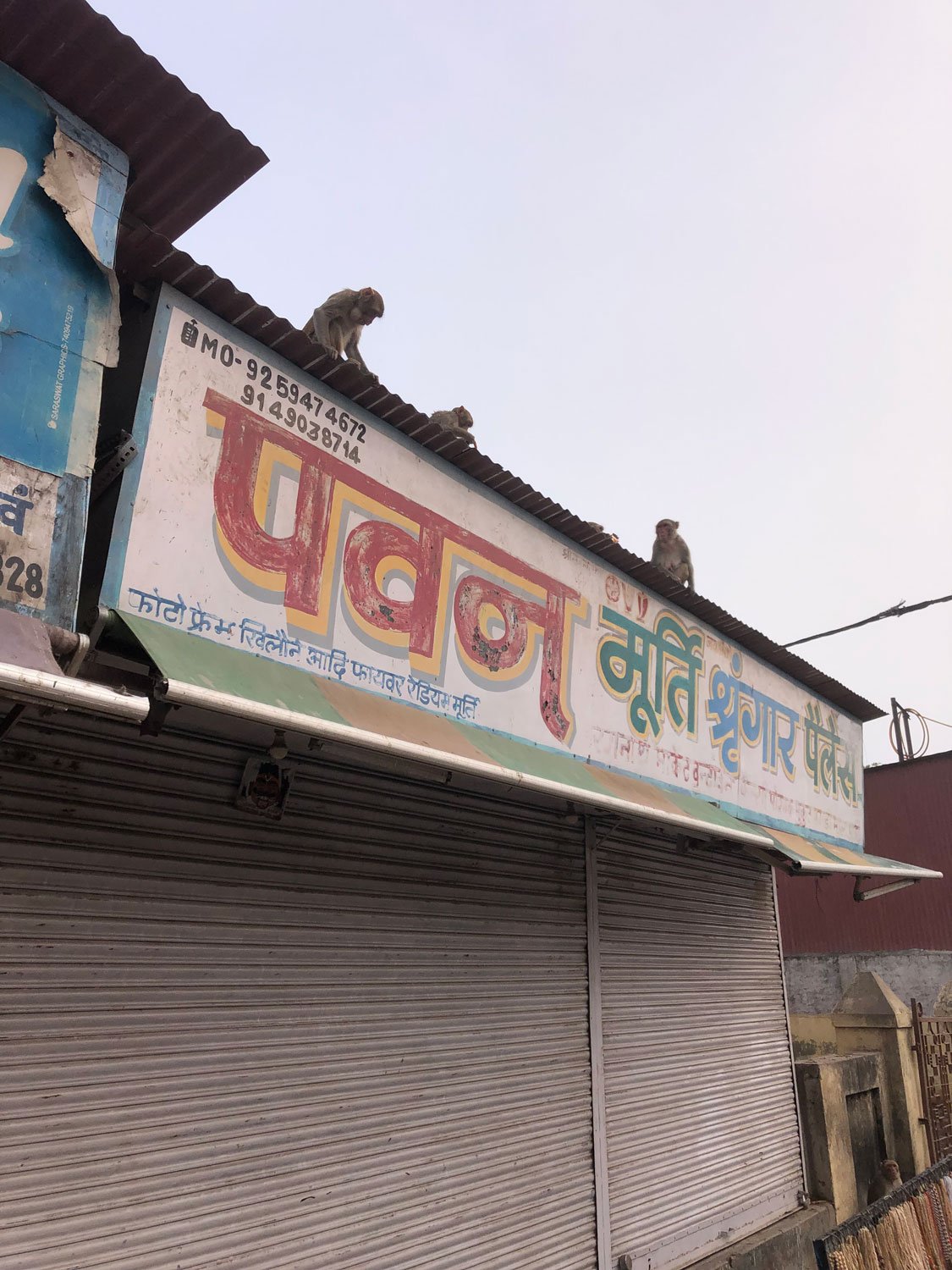
Incidentally, the most amusing misadventure I had was my day trip to Vrindavan to visit a Hindu temple, and was also resolved by community effort. The city is full of rhesus monkeys (see photo), and I had been warned not to eat food in front of them and not wear my eyeglasses when walking outside. So, on the afternoon of my visit, I carefully took my glasses off and tucked them away safely. When it came time to leave, I stood next to a fruit and juice stand waiting for my Uber ride. Since I didn’t see any monkeys around, I put my eyeglasses back on to be able to identify the car. Within minutes, a monkey snuck up behind me, grabbed the glasses off my face, and ran up to the roof of the nearest building. He was dangling my eyeglasses in my direction, clearly indicating that this was a ransom situation! So, I grabbed a couple bunches of bananas from the fruit stall and started throwing them up at the monkey, attempting to make an exchange. He ate some of the bananas, while others were taken by other monkeys or fell back to the ground where the street dogs and cows got their share as well. The problem was that the monkey could adeptly eat the banana with one hand and hold my glasses with the other, allowing it to hold out for more booty. Monkeys are really clever and this is quite a racket they have going! Finally, a local onlooker produced a box of mango juice with a straw and threw it up to the monkey; and because the drink box required the monkey to use two hands, my glasses fell to the ground. Success at last!
When I returned from India in 2012, I let the dust settle for many months. After that, I found myself in the process of “creative recovery” – painting, drawing, and developing the ideas for a self-help book now published with the title 5 Steps to Tame the Overwhelmed Mind: The 5STOM Method for Restoring Your Inner Equilibrium (published in 2025). I feel a similar process is underway this year as well, though I’m not quite sure where it will lead me. The only realization I can verbalize so far is that when I perceived the interconnectedness between me and the Indian people that I saw struggling, I saw us as equals. Any differences in education or achievements that could create the sense of separation or hierarchy between “me” and “them” collapsed, and I was left simply with humility and humanity.
Since my return to the U.S. in February, I have been pondering why I haven’t felt the same level and constancy of compassion for my fellow Americans as I felt in India, outside of times of major catastrophes like during the COVID-19 epidemic and when Hurricane Helene struck Asheville, NC in 2024. I remember that on my final day in India, I visited the memorial park in Delhi where Mahatma Gandhi was assassinated. It was January 30th (coincidentally, falling on the same date as Gandhi’s passing in 1948) and I was reminded of one of his quotes, “The best way to find yourself is to lose yourself in the service of others.” Perhaps Gandhi’s message is part of the answer to my ponderance… Though I’m now back to my life in the U.S., I don’t need to turn away from what I saw, leaving it in the past as I move into the future. I can carry this life-altering lesson with me. Going forward, I intend to continue to be open to the possibility that life offers creative opportunities to play whatever role I can to help.
* The “5STOM Method” was developed by myself and my colleague, Grace Elizabeth Wormwood, as a step-by-step process to move from inner turmoil to a state of peace. The method can be learned online, in workshops, and is presented in the book, 5 Steps to Tame the Overwhelmed Mind: The 5STOM Method for Restoring Your Inner Equilibrium (2025).